About Cergai (/sɜːrˈɡeɪ/)
Multi-model AI synthesis for people who want one honest answer, not four hedged ones.
Last updated: May 18, 2026
What Cergai Is
Every major AI model will confidently give you a different answer to the same question. ChatGPT leans one way, Claude another, Gemini a third, Grok a fourth. If you only ask one, you get one model's priors dressed up as the truth. If you ask all four, you get four contradictory paragraphs and no answer.
Cergai queries four frontier models in parallel, then uses an independent fifth model to synthesize what they actually said into a single verdict. When the four agree, you get a direct answer. When they split, Cergai tells you exactly where and why — no fake middle, no editorializing.
The product is built around one idea: the interesting signal is in convergence and divergence between independent AI architectures. That's what we surface.
The Models
Four independent frontier models run every query in parallel. Each is queried with the same question and no knowledge of the others' answers.
Cergai's only job is to read the four responses and write the verdict. It is deliberately not one of the four — using any of them to synthesize their own output would bias the verdict toward that model's priors.
Cergai is open-weights and runs on our own infrastructure, so there's no hidden editorial layer from a major lab between you and the verdict.
Search
Type any question — factual, forecast, contested, weird. Cergai runs all four models on it in parallel and shows you one synthesized answer plus a full breakdown of where each model stood.
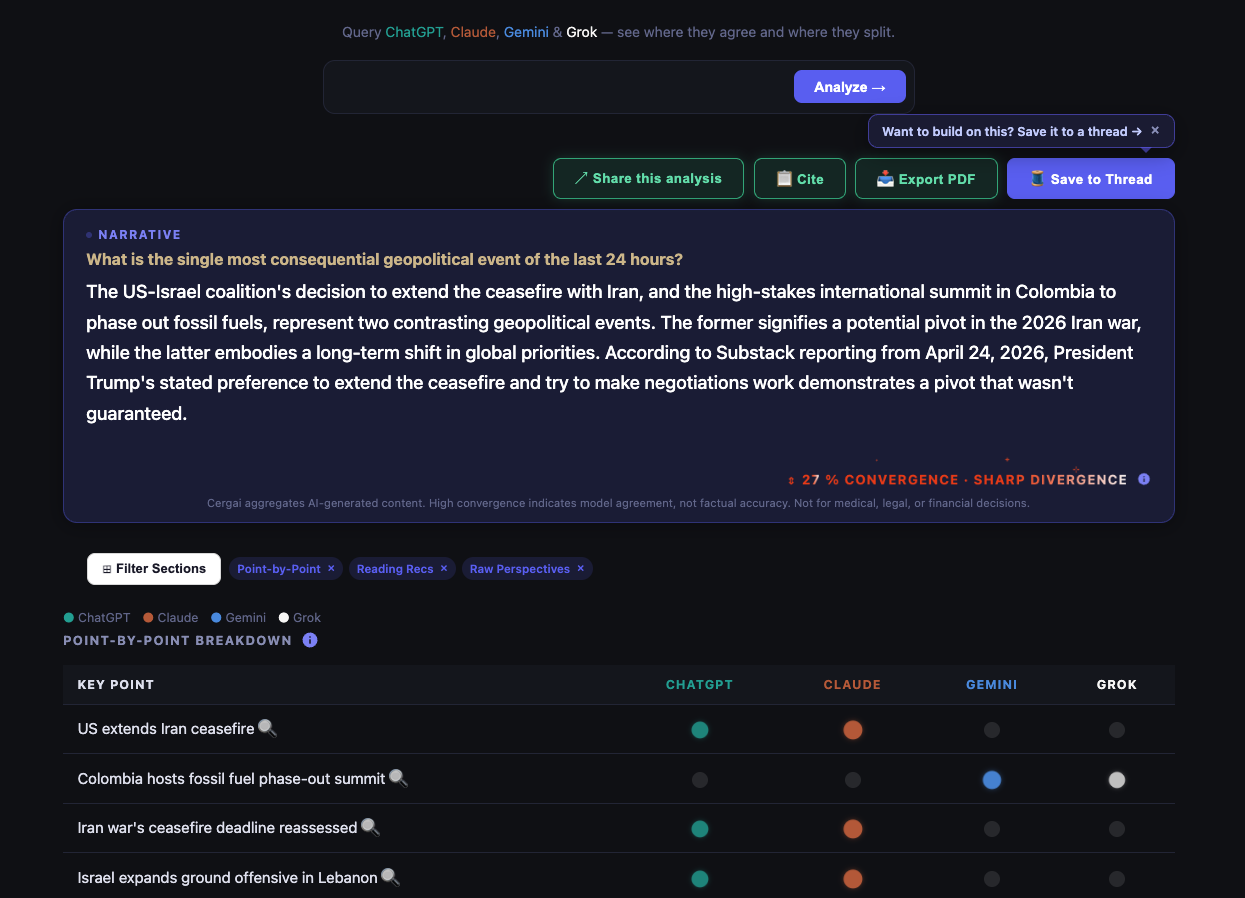
On every result you'll see:
- A verdict — one direct answer in two or three sentences.
- A convergence score (0–100%) showing how tightly the four models agreed, along with a tier label (Strong Consensus, Broad Agreement, Split Views, or Sharp Divergence).
- A Point-by-Point Breakdown table listing the key claims and which of the four models supported each.
- A Where They Agreed and Where They Diverged section so you can see the texture of the inter-model signal.
- Reading Recs — relevant articles you can jump to for deeper context.
- The four raw perspectives — each model's untouched answer if you want to read it directly.
Convergence Score
Every result is tagged with a convergence percentage (0–100%) and a tier. The number is not a vibe — it's computed by a fixed formula from two things: how the four models clustered on the answer, and how many of them supported each row of the Point-by-Point Breakdown. The entire method is published below, so you can recompute any score by hand — the way you can rebuild a baseball WAR from its inputs.
A reserved 0% ("Mythical") is possible only in the extreme case: all four models pick four distinct answers, none refuse, and every Point-by-Point row is supported by exactly one model.
How the number is calculated
Five steps. Nothing hidden — a reader with no access to the source can reproduce any score.
Step 1 — Classify each of the four models' stances. For every question we extract each model's committed pick or stance (e.g. its yes/no, or which option it chose). Models that clearly land on the same answer share a cluster; models that land elsewhere form their own.
Step 2 — Fold in refusals. A model that fully refuses (its Point-by-Point column is empty) is still shown as "Declined," but for the math it's folded into the least-popular committed stance and counted as agreement there. One consequence to state plainly: any question where a model refuses can only land in Strong Consensus, Split Views, or the top (25–44%) half of Sharp Divergence — never Broad Agreement, and never the reserved 0%.
Step 3 — The resulting cluster pattern locks a band. Once the four stances (post-fold) are grouped, the shape of the grouping fixes both the tier and the convergence floor and ceiling the final score must fall between:
Step 4 — Point-by-Point rows position the score inside the band. For each non-gap row of the breakdown, count how many of the four models "lit" it (1–4). Each lit-count is worth a multiplier that depends on the band — agreement is weighted harder in the lower bands, where any point the models do converge on is a rare outlier:
Step 5 — Run the formula and round up. Spread the band's width evenly across the rows, weight each row by its multiplier, add that to the floor, clamp to the ceiling, and round up:
(The value stored internally is divergence = 100 − convergence%, so reading it back reproduces the displayed percentage exactly.)
Worked example 1 — Strong Consensus, two different results
A. A lower Strong Consensus — 88%
All four models give the same answer → 4/4 agree → Strong Consensus (floor 85, ceiling 100, width 15). The breakdown has 4 non-gap rows; two are lit by 2 models and two by a single model → lit-counts [2, 2, 1, 1].
Result: 88% — Strong Consensus.
B. A higher Strong Consensus — 96%
Same pattern (4/4 → Strong Consensus, floor 85, width 15), same 4 rows, but the models overlap far more on the substance: two rows are lit by all four and two by two models → lit-counts [4, 4, 2, 2].
Result: 96% — Strong Consensus.
Worked example 2 — Sharp Divergence, spanning both halves
A. A four-way scatter — 20%
All four models pick four different answers → 1v1v1v1 → Sharp Divergence, scatter half (floor 1, ceiling 24, width 23). The breakdown has 5 non-gap rows; four are lit by 2 models and one by a single model → lit-counts [2, 2, 2, 2, 1].
Result: 20% — Sharp Divergence.
B. A pair-plus-two-loners split — 38%
Two models agree, the other two each go their own way → 2v1v1 → Sharp Divergence, pair half (floor 25, ceiling 44, width 19). The breakdown has 3 non-gap rows; one is lit by 3 models and two by a single model → lit-counts [3, 1, 1].
Result: 38% — Sharp Divergence.
High convergence means the models agreed — not that they're necessarily right. Cergai surfaces inter-model signal; you still think.
Newsletters
A daily brief that runs the same multi-model pipeline on the stories that matter in your verticals, delivered to your inbox each morning.
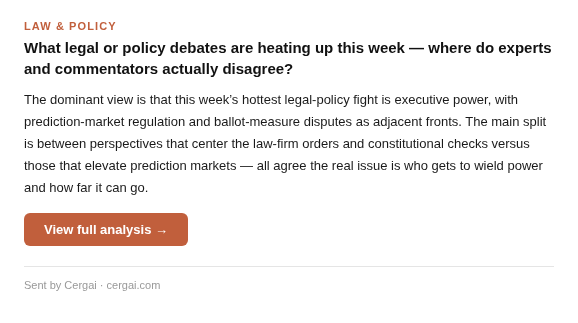
Standard newsletters
Curated topic feeds — Global Politics, Markets, Tech & AI, Sports, Science & Health, Health & Medicine, Law & Policy, Film & Media, Business Strategy. Each runs a tight prompt on the cadence that fits the vertical. Free users get one; Pro unlocks the full set.
Custom newsletters (Pro)
Build your own: add 1–3 prompts, pick a title, any days of the week, any time. Cergai delivers the verdicts at your chosen time.
SMS delivery for newsletters is coming soon — we're finishing carrier approval.
Research Threads
A research thread is a persistent, named collection of Cergai analyses that build on each other. Save any result to a thread, ask the next question, save that too — the thread keeps your queries linked so you can come back and see the bigger picture.
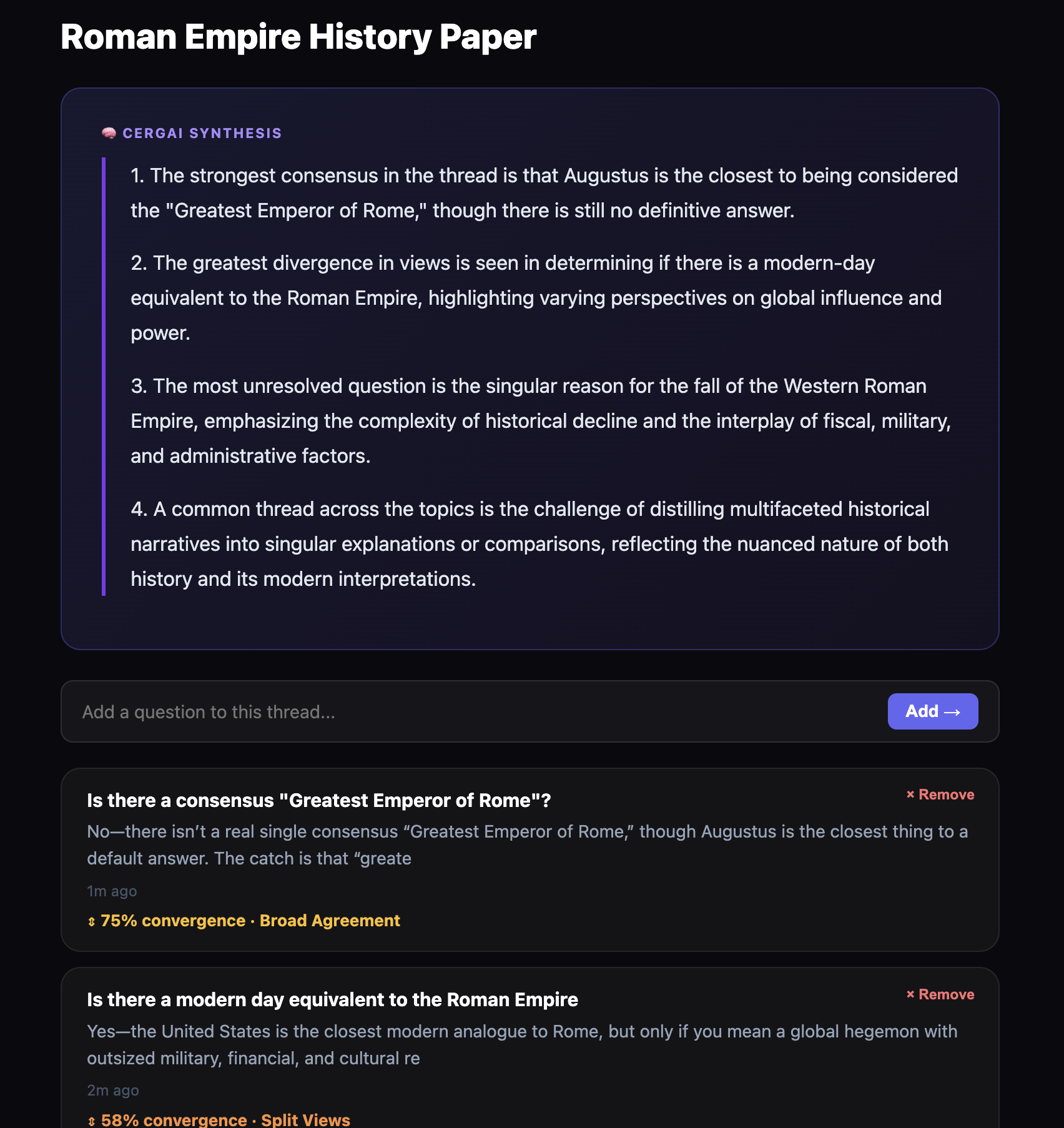
Threads are attached to your account and private by default. Free users get a small number of threads; Pro removes the cap.
The Game
A card-swipe game where Cergai shows you a real synthesized result and asks: did the four models agree or split on this one? Guess, then see the actual convergence score and which models sat where.
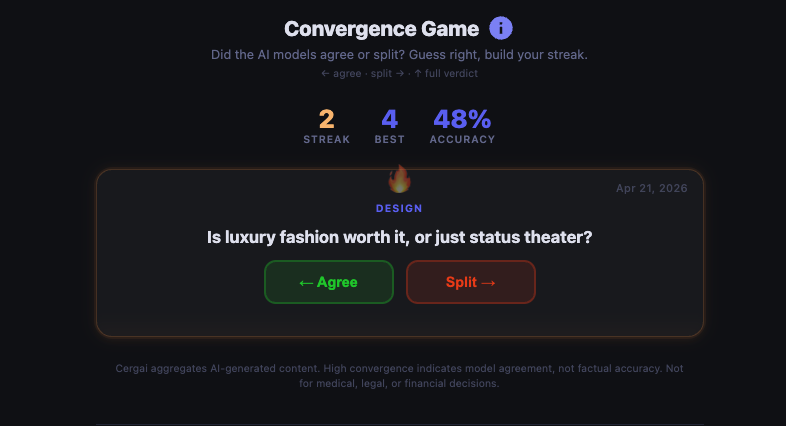
The game uses real Cergai results — filtered to keep things high-signal. We exclude newsletter-generated searches, anything with personal information, and adult content. Build a streak, climb the leaderboard, and develop a feel for where AI models tend to agree and where they don't.
Messages
Cergai has built-in direct messaging — any user can message another user. Useful for sharing a specific analysis, pinging a research thread, or just chatting about something you both searched. Messaging is strictly opt-in: no one can DM you unless you've allowed it in account settings.
Privacy & Data
Cergai stores your queries, your results, and (if you've saved them) your threads. Queries are not sold or shared for advertising. Phone numbers — for SMS notifications — are only shared with Twilio for delivery, never with third parties for marketing.
Full details: Privacy Policy · Terms of Service · SMS program details.